As a man over 40 who is making his way through the world of work in an uncertain time, are you portraying yourself as the truly confident, capable guy you are? Whether you’re trying to land a job, advance your career or hold onto the position you have right now, you need to be sure you’re presenting the best you possible. Ask yourself these questions in our handy checklist to get on your way.
Appearance
Outdated clothes and hair along with poor grooming can make a negative impression on a current or future employer. To make sure you’re up-to-date, ask yourself these questions:
Is your wardrobe polished, professional, current and projecting confidence?
Is your hair giving away your age? When was the last time you had it cut, styled or possibly even colored to keep up with the times?
Do you keep your facial hair shaved and/or trimmed?
Do you look like you take care of yourself? Could stained teeth or bitten nails be detracting from your total package?
Resume
You’ve been working for awhile, and your experience is a plus to potential employers. But don’t let your resume date you -- use it to show off your assets. Ask yourself these questions:
Have you removed older, irrelevant experience and degrees?
Have you played up your most relevant recent experience?
Have you emphasized current technical skills, such as familiarity with the latest computer programs?
Did you leave off potential discrimination points like age, weight and marital status?
Have you played down inflated job titles, if necessary -- like vice president -- in order to avoid appearing overqualified (AKA too expensive)?
Interview
So they like your resume and called you in for an interview. Ready to show them what you’ve got? Ask yourself these questions:
Are you comfortable with the fact someone younger may be interviewing you?
Have you kept up with current industry terms as well as the potential employer’s place in the industry?
Have you prepared examples of past accomplishments that illustrate your flexibility, loyalty, patience and willingness to be a team player -- all important assets of older workers?
How’s your attitude? Do you project confidence (but not overconfidence), positive energy and unflappability?
Are you prepared for surprises, such as a group interview?
In the bleak midwinter Poverty looms for the long-term unemployed OVER the past two years Moira McKamey has had to adjust to a very different way of life. She lost her job in November 2008, one of 8,000 workers fired from an air-freight hub in Wilmington, Ohio. The departure of DHL, a delivery company, was quick and devastating; as if a tornado had ripped through Main Street. A few weeks after Mrs McKamey was sacked she and her husband, Randy, spoke to The Economist in their small farmhouse. Perched on a chair near her Christmas tree, Mrs McKamey could not help but cry.
Since then, despite a burst of fame that has seen them featured on wire-service reports, in newspapers and on television, not much has changed for the McKameys. The Christmas tree is decorated, but Mrs McKamey is trying to prepare for Christmas without spending money. “I’m the clearance-sale queen,” she jokes. Her husband is scraping together money to pay for his combine, seed and fertiliser. Mrs McKamey is still without a job. “If it hadn’t been for his crops,” she says, “we wouldn’t have made it.”
Hardship has spread to neighbours, too. In January 2010 Kevin Eakins, who lives down the road, lost his job as a fork-lift operator at an animal-pharmaceuticals firm. A few months earlier Jacki, his wife, had been sacked from her job at a trucking company. “It’s been a struggle,” Mrs Eakins sighs. Both of them have searched for jobs for months, to no avail.
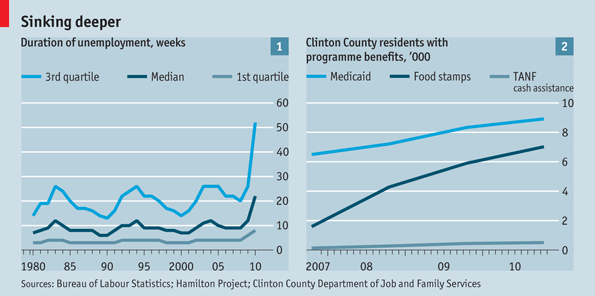
Fifteen million Americans are now unemployed, according to the most recent jobs report. The unemployment rate for November inched up to 9.8%. The grimmest numbers, however, are for the long-term unemployed (see chart 1): 6.3m people, 42% of those unemployed, have been jobless for more than 26 weeks. That number does not include 2.5m people who want a job but who have not looked for a month or more, or the 9m who want full-time work but can only find part-time openings. America, unlike some European countries, is not used to such high numbers. No recent recession has seen so many Americans out of a job for so long. Now, with millions fallen from the ranks of the employed, the federal government has deployed its imperfect safety net to catch them.
Net loss
The unemployment rate in Clinton County, which contains Wilmington, is 15.8%, the highest in Ohio, itself one of the hardest-hit states. Wilmington has had some successes. The county won control of the air-freight park and may be able to reuse it. A “Buy Local” campaign is keeping some businesses afloat. But without a lot of federal aid, the town would be desolate.
The first and most generous form of help is unemployment insurance. It is usually paid from a state trust fund and lasts only 26 weeks, as long as recipients meet criteria such as continuing to look for work. But Ohio is one of many states whose unemployment fund is empty. Since 2008 the federal government has paid for an extension of benefits, now to 99 weeks in battered states. Last year this helped keep 3.3m Americans out of poverty, according to the Centre on Budget and Policy Priorities, a think-tank. If Congress passes Barack Obama’s recent deal with Republicans, workers will go on being eligible for the 99-week maximum payment until the end of next year. But even so, 99 weeks is all anyone can get, and many workers have already reached that limit.
The federal government also provides money for retraining, through grants and programmes such as the 12-year-old Workforce Investment Act. A national emergency grant from the Labour Department is funnelling about $4.5m to Clinton County. This has helped some displaced workers find new jobs as welders, for example, or dental assistants. But training does not always yield a job, and even extended unemployment benefits expire eventually. Mrs McKamey, 51 when she was sacked, decided to retrain for a career in health care. After months of schooling and hard work (“She studied her flash cards constantly,” Mr McKamey says proudly), she became a certified medical assistant. She even got a job, sort of. She had a 90-day trial, but was not hired at the end of it.
These days Mrs McKamey is trying not to be discouraged. But her husband is already raiding his farm account to pay for household expenses. They had health insurance through the COBRA law, which lets a fired worker continue in his or her former health plan for up to 18 months. The federal stimulus subsidised part of the premium. But the McKameys met COBRA’s 18-month limit in May. Now they are without insurance. “We hardly get sick at all,” Mrs McKamey says hopefully. “I’m one of those people, I bring hand sanitiser with me everywhere.”
The Eakinses are trying to stay cheerful as well. They trawl the internet for jobs. Some days they drive to nearby towns; if they see a loading dock, they pull in to see whether Mr Eakins might lend a hand. But Mrs Eakins is frustrated that companies seem to have only part-time work. “Drive an hour away, for a minimum-wage job for four or six hours?” she asks. “All you’d be doing is paying for gas.” For now, the Eakinses’ unemployment insurance ($224 a week for her, $349 a week for him), is just enough for them to meet their refinanced house and car payments; but in another year at most it will be gone.
Judy Eschmann, director of Clinton County’s Department of Job and Family Services, is getting more and more calls from anxious workers. Close to exhausting their unemployment benefits, they worry about what comes next. Ms Eschmann administers the federal programmes supposed to help, including food stamps, Medicaid and cash assistance. Enrolment has already surged (see chart 2). In addition to fielding calls and visitors, Ms Eschmann’s staff are venturing outdoors to tell residents about the aid available. Many are too proud to visit the office itself.
The programmes available for the poor are at once limited and helpful, meagre and costly. Food stamps, delivered these days in the form of debit cards for groceries, are available for any household whose gross income does not exceed 130% of federal poverty guidelines—for example, $28,668 for a family of four. In normal circumstances an unemployed, able-bodied worker below that level gets food stamps for no more than three months in a three-year period. Thanks to Ohio’s high unemployment rate, that limit has been waived until October 2011. In September the average recipient in Ohio got $141 a month for groceries, or $4.70 per day—not much, but more than usual thanks to the stimulus package.
Don’t know when I’ll be back again Health care is another big problem. Medicaid provides health insurance for the poor. To qualify, a family of four would have to have a monthly income of no more than $1,654. And Medicaid is available only to specific groups of poor people, such as families with young children and pregnant women. In Ohio, children ineligible for Medicaid may qualify for a state programme. Others, however, are simply seeking care where they can. In Wilmington volunteers staff a free health clinic on Thursday evenings. Patients often begin to queue at 3pm. Denise Kleinhenz, a nurse who helps run the clinic, says that many come after months of neglect. Some have first tried treating themselves with cheap veterinary drugs.
Once a worker has exhausted unemployment benefit, the only form of cash assistance is through Temporary Assistance for Needy Families (TANF), the federal programme that replaced welfare in 1996. The recession, however, has been a strain. First, states receive TANF money as block grants from Washington, DC, so the funding does not rise with demand. The stimulus included an emergency boost, but this expired in September and is not being renewed. Second, states have long spent the bulk of their TANF money on programmes that encourage people into work, such as child care. This continued even as work was nowhere to be found. Last year Ohio spent only 25% of its TANF money on cash assistance.
Whereas unemployment benefits are based on a worker’s previous wages, TANF payments are much more modest. A family of four in Ohio, for example, gets a mere $536 in cash assistance each month. When Ms Eschmann explains this to applicants, a torrent of questions follows. “Suddenly they start to panic,” she says. “ ‘Who will make up the difference of my rent?’ How do I pay my car insurance in order to look for work?’ ”
Community groups provide some extra support. In Wilmington a non-profit organisation offers help with heating bills. The homeless shelter has extended its maximum stay to 90 days. Sugartree Ministries, a soup kitchen downtown, got a lovely renovation thanks to a television show that featured Mrs McKamey.
But such services are designed to sustain families through a tough spell, not to support them in the long term. Over time, unemployment begins to breed its own problems. Workers may be discouraged or their skills may decay. Employers may be wary of someone who has been out of the labour force for more than a year. The most desperate may try to qualify for disability payments, an expensive federal programme for those physically unable to work. When the economy recovers at last, many will be left behind.
Facebook privacy policies keep going down the drain. That's enough reason for many to abandon it. Here you will find nine more:
After some reflection, I've decided to delete my account on Facebook. I'd like to encourage you to do the same. This is part altruism and part selfish. The altruism part is that I think Facebook, as a company, is unethical. The selfish part is that I'd like my own social network to migrate away from Facebook so that I'm not missing anything. In any event, here's my "Top Ten" reasons for why you should join me and many others and delete your account.
10. Facebook's Terms Of Service are completely one-sided
Let's start with the basics. Facebook's Terms Of Service state that not only do they own your data (section 2.1), but if you don't keep it up to date and accurate (section 4.6), they can terminate your account (section 14). You could argue that the terms are just protecting Facebook's interests, and are not in practice enforced, but in the context of their other activities, this defense is pretty weak. As you'll see, there's no reason to give them the benefit of the doubt. Essentially, they see their customers as unpaid employees for crowd-sourcing ad-targeting data. 9. Facebook's CEO has a documented history of unethical behavior
From the very beginning of Facebook's existence, there are questions about Zuckerberg's ethics. According to BusinessInsider.com, he used Facebook user data to guess email passwords and read personal email in order to discredit his rivals. These allegations, albeit unproven and somewhat dated, nonetheless raise troubling questions about the ethics of the CEO of the world's largest social network. They're particularly compelling given that Facebook chose to fork over $65M to settle a related lawsuit alleging that Zuckerberg had actually stolen the idea for Facebook. 8. Facebook has flat out declared war on privacy
Founder and CEO of Facebook, in defense of Facebook's privacy changes last January: "People have really gotten comfortable not only sharing more information and different kinds, but more openly and with more people. That social norm is just something that has evolved over time." More recently, in introducing the Open Graph API: "... the default is now social." Essentially, this means Facebook not only wants to know everything about you, and own that data, but to make it available to everybody. Which would not, by itself, necessarily be unethical, except that ... 7. Facebook is pulling a classic bait-and-switch
At the same time that they're telling developers how to access your data with new APIs, they are relatively quiet about explaining the implications of that to members. What this amounts to is a bait-and-switch. Facebook gets you to share information that you might not otherwise share, and then they make it publicly available. Since they are in the business of monetizing information about you for advertising purposes, this amounts to tricking their users into giving advertisers information about themselves. This is why Facebook is so much worse than Twitter in this regard: Twitter has made only the simplest (and thus, more credible) privacy claims and their customers know up front that all their tweets are public. It's also why the FTC is getting involved, and people are suing them (and winning).
Check out this excellent timeline from the EFF documenting the changes to Facebook's privacy policy. 6. Facebook is a bully
When Pete Warden demonstrated just how this bait-and-switch works (by crawling all the data that Facebook's privacy settings changes had inadvertently made public) they sued him. Keep in mind, this happened just before they announced the Open Graph API and stated that the "default is now social." So why sue an independent software developer and fledgling entrepreneur for making data publicly available when you're actually already planning to do that yourself? Their real agenda is pretty clear: they don't want their membership to know how much data is really available. It's one thing to talk to developers about how great all this sharing is going to be; quite another to actually see what that means in the form of files anyone can download and load into MatLab. 5. Even your private data is shared with applications
At this point, all your data is shared with applications that you install. Which means now you're not only trusting Facebook, but the application developers, too, many of whom are too small to worry much about keeping your data secure. And some of whom might be even more ethically challenged than Facebook. In practice, what this means is that all your data - all of it - must be effectively considered public, unless you simply never use any Facebook applications at all. Coupled with the OpenGraph API, you are no longer trusting Facebook, but the Facebook ecosystem. 4. Facebook is not technically competent enough to be trusted
Even if we weren't talking about ethical issues here, I can't trust Facebook's technical competence to make sure my data isn't hijacked. For example, their recent introduction of their "Like" button makes it rather easy for spammers to gain access to my feed and spam my social network. Or how about this gem for harvesting profile data? These are just the latest of a series of Keystone Kops mistakes, such as accidentally making users' profiles completely public, or the cross-site scripting hole that took them over two weeks to fix. They either don't care too much about your privacy or don't really have very good engineers, or perhaps both. 3. Facebook makes it incredibly difficult to truly delete your account
It's one thing to make data public or even mislead users about doing so; but where I really draw the line is that, once you decide you've had enough, it's pretty tricky to really delete your account. They make no promises about deleting your data and every application you've used may keep it as well. On top of that, account deletion is incredibly (and intentionally) confusing. When you go to your account settings, you're given an option to deactivate your account, which turns out not to be the same thing as deleting it. Deactivating means you can still be tagged in photos and be spammed by Facebook (you actually have to opt out of getting emails as part of the deactivation, an incredibly easy detail to overlook, since you think you're deleting your account). Finally, the moment you log back in, you're back like nothing ever happened! In fact, it's really not much different from not logging in for awhile. To actually delete your account, you have to find a link buried in the on-line help (by "buried" I mean it takes five clicks to get there). Or you can just click here. Basically, Facebook is trying to trick their users into allowing them to keep their data even after they've "deleted" their account. 2. Facebook doesn't (really) support the Open Web
The so-called Open Graph API is named so as to disguise its fundamentally closed nature. It's bad enough that the idea here is that we all pitch in and make it easier than ever to help Facebook collect more data about you. It's bad enough that most consumers will have no idea that this data is basically public. It's bad enough that they claim to own this data and are aiming to be the one source for accessing it. But then they are disingenuous enough to call it "open," when, in fact, it is completely proprietary to Facebook. You can't use this feature unless you're on Facebook. A truly open implementation would work with whichever social network we prefer, and it would look something like OpenLike. Similarly, they implement just enough of OpenID to claim they support it, while aggressively promoting a proprietary alternative, Facebook Connect. 1. The Facebook application itself sucks
Between the farms and the mafia wars and the "top news" (which always guesses wrong - is that configurable somehow?) and the myriad privacy settings and the annoying ads (with all that data about me, the best they can apparently do is promote dating sites, because, uh, I'm single) and the thousands upon thousands of crappy applications, Facebook is almost completely useless to me at this point. Yes, I could probably customize it better, but the navigation is ridiculous, so I don't bother. (And, yet, somehow, I can't even change colors or apply themes or do anything to make my page look personalized.) Let's not even get into how slowly your feed page loads. Basically, at this point, Facebook is more annoying than anything else.
Top Ten Reasons You Should Quit Facebook
Facebook is clearly determined to add every feature of every competing social network in an attempt to take over the Web (this is a never-ending quest that goes back to AOL and those damn CDs that were practically falling out of the sky). While Twitter isn't the most usable thing in the world, at least they've tried to stay focused and aren't trying to be everything to everyone.
I often hear people talking about Facebook as though they were some sort of monopoly or public trust. Well, they aren't. They owe us nothing. They can do whatever they want, within the bounds of the laws. (And keep in mind, even those criteria are pretty murky when it comes to social networking.) But that doesn't mean we have to actually put up with them. Furthermore, their long-term success is by no means guaranteed - have we all forgotten MySpace? Oh, right, we have. Regardless of the hype, the fact remains that Sergei Brin or Bill Gates or Warren Buffett could personally acquire a majority stake in Facebook without even straining their bank account. And Facebook's revenue remains more or less a rounding error for more established tech companies.
While social networking is a fun new application category enjoying remarkable growth, Facebook isn't the only game in town. I don't like their application nor how they do business and so I've made my choice to use other providers. And so can you.
Dan Yoder is a serial entrepreneur and the VP of Engineering at Border Stylo, a Hollywood-based social media startup. He can be reached on Twitter as @dyoder.
Disclosure by Dan Yoder: I'm the VP of Engineering for a Hollywood-based social media startup, BorderStylo. The opinions expressed here are purely my own and are not in any way endorsed by my employer. While I do not see our applications as directly competitive to Facebook, nor have I presented them as such, it would be disingenuous not to mention this.
Thanks to David Harthcock for creating the great "Ban Facebook" graphic.
The author of this post can be contacted at tips@gizmodo.com Citeste mai mult...